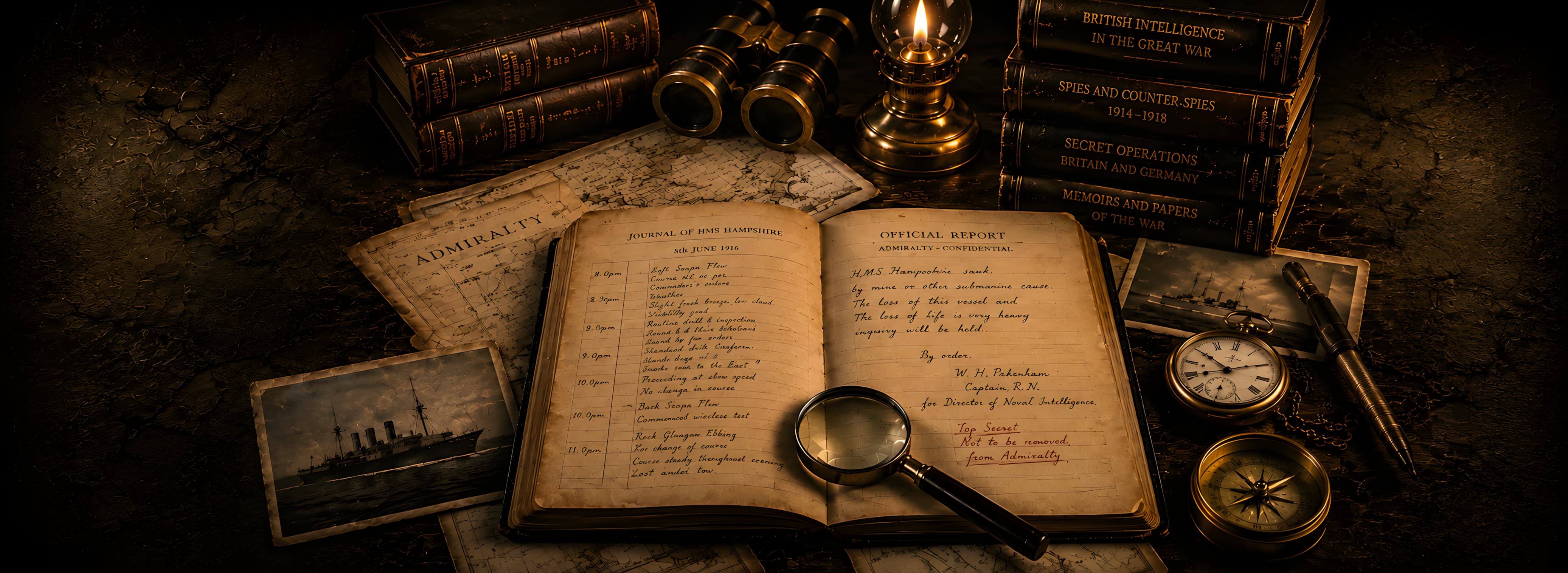

The World in June 1916
When Lord Kitchener boarded HMS Hampshire on 5 June 1916, the First World War had entered one of its darkest periods.

For almost two years, Europe had been locked in a struggle unlike anything previously experienced. Along the Western Front, British and French armies faced the Germans across an almost continuous line of trenches stretching from the North Sea to the Swiss frontier. Millions of men had already been killed or wounded, yet neither side had achieved the decisive breakthrough that every commander sought.
To the east, Russia was fighting an equally desperate war against Germany and Austria-Hungary. Its armies remained vast, but they were increasingly strained by shortages of weapons, ammunition, transport and supplies. Although the Russian Empire possessed enormous reserves of manpower, its military administration struggled to equip them properly. Corruption within parts of the military and civil administration compounded these problems, while an inefficient transport system left men at the front short of food, clothing and equipment. Many soldiers lacked rifles, boots or even sufficient ammunition. Morale was deteriorating rapidly, and revolutionary feeling was beginning to spread through the country. Tsar Nicholas II understood that unless Russia remained committed to the Allied cause, Germany might be able to transfer huge numbers of troops to the Western Front, potentially changing the course of the war.
Britain therefore regarded Russia's continued participation as essential.
Lord Kitchener
Horatio Herbert Kitchener was already one of the most famous men in the British Empire.
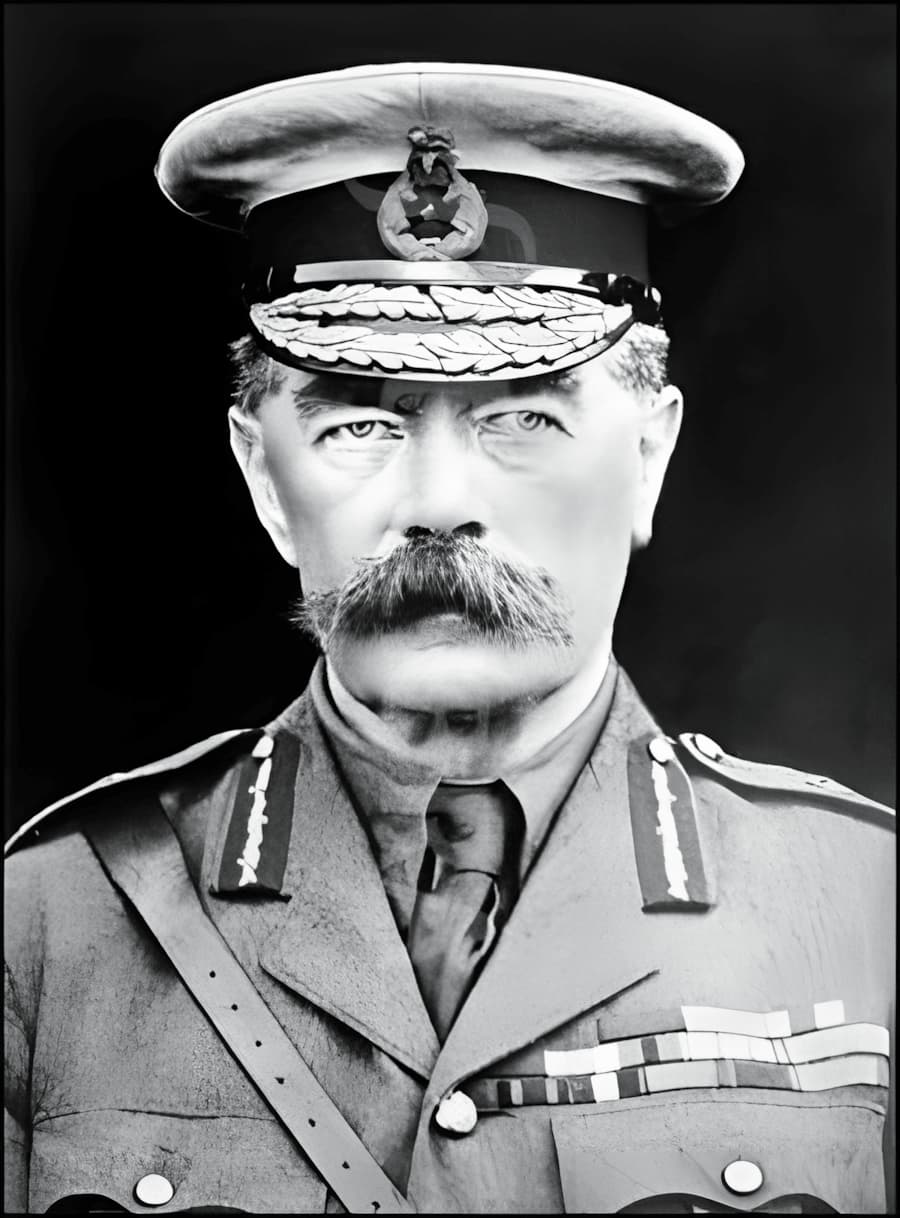
His victories in the Sudan, culminating in the Battle of Omdurman in 1898, and his command during the Second Boer War had made him a national hero. By 1914 he had become Britain's best-known soldier, admired for his organisational ability, determination and immense personal authority.
Unlike most Cabinet ministers, Kitchener was not a politician, which meant he had to send his under-secretary to answer questions in Parliament!
At the outbreak of war, Kitchener was not waiting in Westminster for political office. He was preparing to return to Egypt when the summons came. Britain did not appoint him because he was a politician. He was appointed because, in that moment, he was the one soldier whose name carried authority with the Crown, the Army and the public. Prime Minister H. H. Asquith recognised, too, that the nation needed a figure who inspired immediate public confidence. King George V also strongly favoured Kitchener's appointment. As a result, Kitchener was brought directly into the Cabinet as Secretary of State for War, despite having no parliamentary or party political background. It was an extraordinary appointment, reflecting the exceptional circumstances facing Britain.
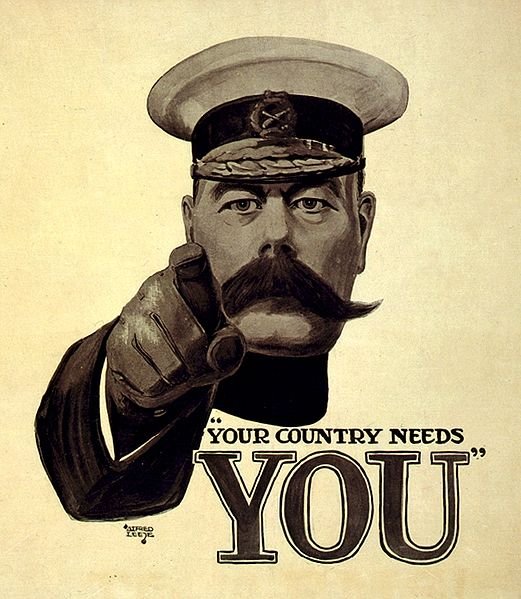
His judgement that the war would last several years — when many expected it to be over by Christmas — proved remarkably accurate. He immediately began raising the volunteer armies that would later become known as "Kitchener's Army", immortalised by Alfred Leete's famous recruitment poster declaring, "Your Country Needs You."
The Mission to Russia
By the summer of 1916 the Allied governments believed a high-level diplomatic mission to Russia had become essential.
The purpose was not merely ceremonial. Britain wished to strengthen cooperation between the Eastern and Western Fronts, discuss the supply of munitions and reassure the Tsar that Britain remained fully committed to the alliance. At the same time, the Russian government hoped that Kitchener's immense prestige might encourage military reform and stiffen the resolve of senior commanders whose administration had become increasingly ineffective. Financial and industrial questions were also expected to feature prominently in the discussions.
David Lloyd George, then Minister of Munitions, had originally been expected to accompany Kitchener. Shortly before departure, however, he withdrew from the mission, citing pressing domestic responsibilities following the Easter Rising in Ireland and the political demands that followed. His place was not filled.
The Journey North
The journey began quietly.
Kitchener and his party travelled by train from King's Cross Station in London to Thurso, the northernmost railway station on the British mainland - Thurso. From there they made the short road journey to Scrabster Harbour.

A small vessel transferred the party across to Scapa Flow, where Admiral Sir John Jellicoe's Grand Fleet lay at anchor following its recent encounter with the German High Seas Fleet at the Battle of Jutland only a few days earlier.
Kitchener lunched aboard Jellicoe's flagship, HMS Iron Duke. Afterwards, he and his party transferred to the armoured cruiser HMS Hampshire, which had been selected to carry them onwards to Archangel in northern Russia.
The Final Voyage
The weather deteriorated rapidly.

Strong north-westerly winds and heavy seas swept across Orkney. Several officers suggested delaying departure, but Kitchener insisted upon maintaining the schedule.
Initially HMS Hampshire was escorted by two destroyers. As conditions worsened into a Force 9 gale, however, the smaller escort vessels were unable to maintain station and were forced to return to Scapa Flow. HMS Hampshire continued alone.
To obtain some shelter from the worst of the weather, Captain Herbert Savill altered course to pass along the western side of Mainland, Orkney, rather than the more exposed eastern route originally intended.
At approximately 7.40 pm, about one and a half miles off Marwick Head, the cruiser struck one of a recently laid field of German mines deployed by the submarine U-75. The explosion tore open her hull. Within around fifteen minutes the ship had rolled heavily to starboard and disappeared beneath the sea.

The Loss
Witnesses later recalled seeing Lord Kitchener standing calmly on the quarterdeck with members of his staff as the ship settled.
No reliable witness ever saw him leave the vessel.
The sea was so violent that launching boats proved almost impossible. Those that reached the water were smashed against the ship's side or overwhelmed by the surf.
Of approximately 749 people aboard, only twelve survived — and all were members of HMS Hampshire's crew. None of Kitchener's staff survived, nor any officers of either service. His body was never recovered.
The disaster immediately generated rumours.
Stories circulated that Kitchener had escaped, that additional survivors had reached shore, or that the ship had been deliberately betrayed. Official investigations found no evidence to support such claims. The accepted conclusion remains that HMS Hampshire struck a mine laid days earlier by the German submarine U-75, although that has done little to diminish the fascination surrounding the tragedy. And this suspicion forms the heart of "Blackest of Lies".
Further Reading
"Full list of Hampshire's lost published today" - The Orcadian Online, The Orcadian - Hampshire List .
HMS Hampshire 100 - University of Dundee, HMS Hampshire 2016 Expedition .
Herbert Kitchener, 1st Earl Kitchener, Wikipedia article on Lord Kitchener .
HMS Hampshire (1903), Wikipedia article on HMS Hampshire .